When you compare die cutting machine suppliers, look deeper than just looks. Some machines cut faster. Some machines make cleaner edges. You should check setup costs. See how each machine works with your die types. Remember to think about installation. Think about what is needed to keep machines working. Check if the machines handle your materials well. Always compare upfront costs with long-term value. Experts say new technology can help for a long time when you compare die cutting machine suppliers.
Key Takeaways
Check how fast and efficient the machine is. Faster machines help you make more products and save time.
Look at the different models and features. Pick a machine that matches what you need, like speed or special jobs.
Think about costs over time. Do not just look at the first price. Remember to add costs for fixing, extra parts, and supplies.
Find out what people say about the supplier. Good suppliers give you machines you can trust and help when you need it.
Make sure you can talk easily with the supplier. Fast replies and honest answers help you work well together.
Key Criteria to Compare Die Cutting Machine Suppliers
Machine Speed and Efficiency
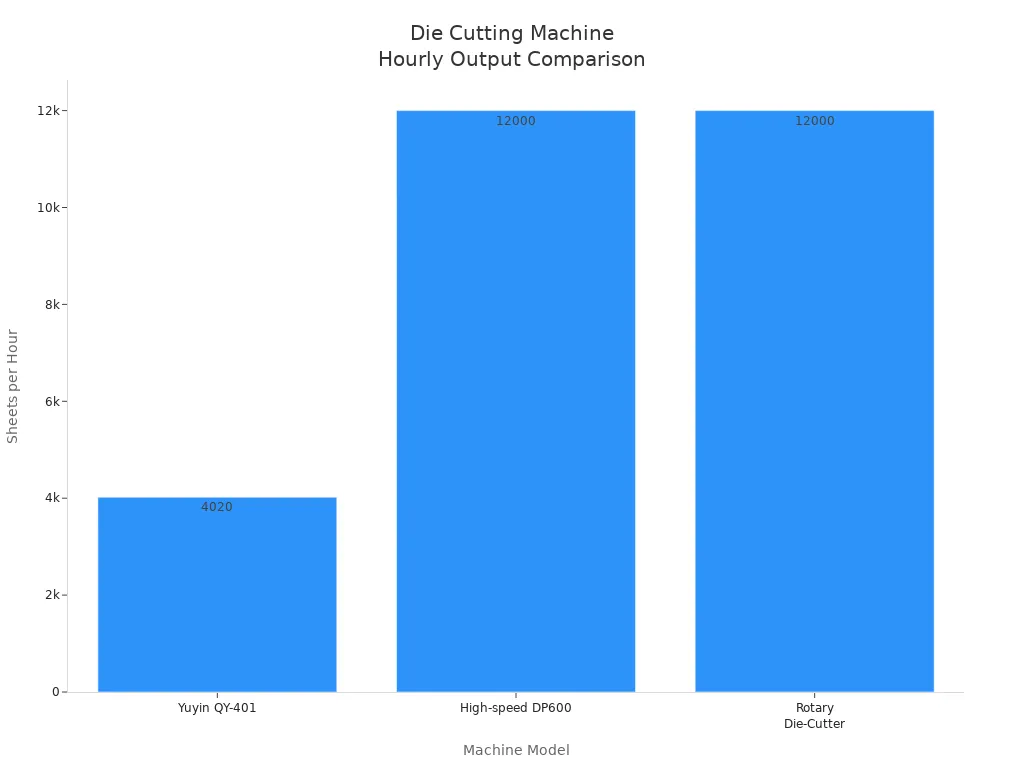
When you compare die cutting machines, speed matters a lot. You need machines that can keep up with your work. Some top machines can cut up to 200 times each minute. The best die cutting machines can make more than 20,000 pieces every hour. This means you finish more products in less time.
Here’s a simple table to show how fast some machines are:
Machine Model | Production Speed (cuts/min) | Production Output (sheets/hour) |
Yuyin QY-401 | 67 | 4,020 |
High-speed DP600 | 200 | 12,000 |
Latest Bobst Model | N/A | >12,000 |
Rotary Die-Cutter | 200 sheets/min | 12,000 |
You should also look for machines that cut very accurately. The best ones can cut within ±0.01 mm. This helps your products look neat and professional.
Model Range and Options
It is good to have choices when you buy die cutting machines. The best brands have many models with different features. Some machines are made for speed. Others are better for custom jobs. Here is a table to help you see the options:
Model | Manufacturer | Features |
Bobst EXPERTCUT 106 PER | Bobst | High-speed, precision, advanced automation, quick setup, robust build, safety features. |
Heidelberg Dymatrix 106 Pro | Heidelberg | Adaptable, combines die cutting, embossing, stripping, servo technology, user-friendly interface. |
KAMA ProCut 76 | KAMA | Compact, versatile, hot foil stamping, accurate registration, modular design, energy-efficient. |
Kluge OmniFold 3000 | Brandtjen & Kluge | Versatile, high-speed production, handles a wide range of materials. |
MarquipWardUnited VersaCutter | BW Papersystems | Adaptable for packaging, precise cutting, modular design, advanced control systems. |
You can pick from different types of machines. Manual machines are good for easy jobs and thin things. Digital die cutting machines and electronic die cutting machine models let you make custom designs. Hydraulic machines are strong and do heavy work. Electric machines are quiet and fast. Many people like them for their business. If you want new technology, try machines like the cricut explore air 2 or the Brother Scan N Cut. These let you make special designs and use many materials.
Accessories and Consumables Cost
Remember to think about the cost of accessories and things you use up. These costs can add up over time. You will need to buy ink, dies, and plates often. Some die cutting machines need special dies. These can cost more at first. The good thing is these dies last for thousands of cuts before you need new ones.
Professional die cutting machines usually cost less to run each time you use them. They use less material and fewer supplies. If you use an electronic die cutting machine like the cricut explore air 2, you may pay more for new parts and waste more material, especially if you make a lot of things. Always ask the company about long-term costs before you buy.
Tip: Write down all the supplies you need for each machine. This helps you see the real cost.
After-Sales Support and Resources
Good customer support is very important. Top companies give you many services after you buy your machine. Here are some things to look for:
After-Sales Support Type | Description |
OEM Service Process | A structured approach to tailor equipment to client needs. |
Initial Consultation | Discussing product requirements and production context. |
Custom Engineering | Designing machines with specific features for the client. |
Prototype Production & Testing | Running trial cuts to ensure machine performance. |
Installation & Training | On-site setup and operator training for smooth transitions. |
Ongoing Support & Maintenance | Providing technical assistance, spare parts, and upgrades for optimal performance. |
Most companies give you a one-year warranty. Many will fix problems for free if it is their fault. Some even offer help for as long as you own the machine. Training is important too. Good training teaches you about software, how to use the machine, how to take care of it, and how to fix small problems. This helps your team use the machine safely and well.
Note: Always ask about training and warranty before you buy your machine.
Supplier Reputation and Reviews
You want to buy from suppliers with a good name. Check what other customers say. Look for reviews about how well the machines work, how good the support is, and if they deliver on time. Here are some places to find reviews:
Supplier Name | Description | Customer Reviews Link |
IQS Directory | A comprehensive industrial directory listing leading die cut machine manufacturers and suppliers. | Read Reviews |
Thrust Industries | Known for high-quality standards and timely delivery of die cut parts. | Read Reviews |
Design Converting, Inc. | Offers advanced die cut machines with a focus on customer service. | Read Reviews |
National Rubber Corp. | A leader in die cutting services with a commitment to accuracy. | Read Reviews |
Gardico | Provides a range of die cutting capabilities for various materials. | Read Reviews |
REDCO Rubber Engineering & Development Company | Offers custom die cutting services with a focus on quality and accuracy. | Read Reviews |
Other review sites also rate suppliers on things like delivery and how often people order again. Here is a table to compare:
Company Name | Rating | Reviews | On-Time Delivery | Reorder Rate |
Ruian Ruiting Machinery Co., Ltd. | 5.0/5.0 | 20 | 100.0% | 35% |
Ruian Mosun Machinery Co., Ltd. | 4.8/5.0 | N/A | 100.0% | 39% |
Zhengzhou Allraise Company Ltd. | 4.9/5.0 | N/A | 100.0% | 26% |
If you want machines you can trust, choose the top ten die cutting machine manufacturers or other top-rated companies. These companies have great engineering, new technology, and strong support. You can count on their machines to work well for your business.
Supplier Transparency and Communication
You need a supplier who replies to you quickly. They should give you clear answers. Good communication helps you know what to expect. When you contact them, see how fast they get back to you. Do they answer every question you ask? Do they help you fix problems? These things show if they care about your business.
Here’s a table to help you check how fast suppliers reply:
Best Practice | Description |
Communication | Check if they answer your questions quickly and clearly. |
Customer Service | See if their team is friendly and knows their machines. |
Agility | Find out if they can change your order if needed. |
Response Times | Notice how long it takes for them to reply and help you. |
Issue Resolution Speeds | Watch how fast they fix any problems you have. |
Order Cycle Times | Count the days from order to delivery. |
Completeness and Accuracy | Make sure their answers are right and nothing is missing. |
Forecast Accuracy | See if they can guess your needs and meet them. |
Scalability | Ask if they can handle bigger or smaller orders. |
Baseline Expectations | Set rules for urgent requests and how fast they must reply. |
Tip: Make clear rules with your supplier. Decide what is an urgent request. Write down who to talk to and how fast you want answers. This helps everyone understand what to do.
Documentation and Certifications
You should always ask for proof that a supplier meets safety and quality rules. CE certification is important because it means the machine is safe to use. It follows strict European safety laws. This keeps your team safe at work.
ISO certification, like ISO 9001, is also good to have. It shows the supplier uses good steps to make quality machines. You can trust they care about doing a good job and making customers happy.
International certificates help a supplier stand out. They show the company cares about quality and wants you to trust them. Good suppliers know that quality helps them win more customers.
Look for CE and ISO 9001 certificates.
Ask for copies of all important papers.
Pick suppliers who care about safety and quality.
Note: Certifications keep your business safe and help you avoid big mistakes.
Total Cost of Ownership for Die Cutting Machines
Installation and Training Expenses
Buying a die cutting machine costs more than just the machine. You must think about setup and training. Some suppliers include setup in the price. Others make you pay extra. You may need to pay for workers or special lessons for your team. If you skip training, you might make mistakes and waste materials. Here is a quick look at what you could pay:
Component | Description |
Total purchase + installation | Money spent to buy and set up the machine |
Labour and training needs | Money spent to teach staff and run the machine |
Ask suppliers about these costs before you order. Planning ahead helps you avoid surprises.
Consumables and Replacement Parts
Die cutting machines use supplies and parts that wear out. You need to buy dies, plates, and sometimes ink. Some machines use special dies that last longer. Others need new parts more often. If you use your machine every day, you will spend more on supplies. Make a list of what you need for each machine. This helps you see the real cost over time.
Dies and plates
Ink and adhesives
Cutting mats
Replacement blades
Tip: Keep extra parts ready. You avoid stopping work and keep things moving.
Maintenance and Resale Value
You must keep your die cutting machine in good shape. Regular care keeps your machine working well. Top suppliers say you should check, clean, oil, and adjust your machine every week. If you use your machine a lot, check it more often.
Maintenance Activity | Frequency |
Inspection | Weekly for heavy use, every two weeks or monthly for light use |
Cleaning | Weekly or when needed |
Lubrication | Weekly or when needed |
Calibration | Weekly or when needed |
If you take care of your machine, it lasts longer. You can sell it later for a good price. Machines from trusted brands keep their value better. When you compare suppliers, ask about care help and selling options.
Note: Taking care of your die cutting machine saves money and helps you worry less.
Customer Feedback and Case Studies
Reviews and Testimonials
Customer reviews help you pick the right die cutting machine. People who use these machines share what they like and dislike. You can see what problems come up often. Here are some things customers talk about most:
How reliable the machines are
If the machines are easy to use
How well the machines cut
If features like auto-feed work well
If the machines can cut small, detailed shapes
Worries about how long parts last and getting new ones
Many reviews talk about how simple the machines are to use. Some people really like the auto-feed feature. Others say the machines cut tiny shapes very well. If lots of people mention broken parts, you should ask about getting new parts.
Testimonials are more than just opinions. They tell real stories from people who use these machines at work. You can learn if certain models last a long time. Some users say their machines cut very accurately. Others say it was easy to learn how to use a new machine. These stories help you know what to expect.
Reading reviews and stories helps you find the best die cutting machine. You can avoid problems and choose a machine that lasts.
References and Success Stories
Always ask suppliers for references. Talking to other customers gives you honest answers about the machines. Some companies share case studies. These stories show how die cutting machines fix real problems.
For example, a health care company had trouble cutting thin materials. They worked with Die Technology to solve this. Die Technology made new matched metal blanking dies. This helped the company get better cuts and more work done. The machines lasted longer and worked better. The company told others about their good results.
Stories like this show how the right machine can help your business. You see how suppliers fix problems and help their customers. When you read these stories, you feel sure about your choice.
Final Checklist for Comparing Die Cutting Machine Suppliers
Summarize Findings
You should feel sure before you order. A checklist helps you stay organized. It makes sure you do not miss anything important. When you use a checklist, you check every key point. This way, you do not forget something that could cost you later. Using a checklist keeps your choice clear and fair.
Here’s a simple table you can use as your final checklist:
Criteria | What to Look For |
Supplier Reputation | Check experience, specialization, and if they are a direct manufacturer. |
Post-Sale Support | Look for strong warranty, easy access to spare parts, and helpful tech support. |
Customer Testimonials | Read reviews, ask for references, and look at case studies from real customers. |
Machine Speed & Models | Compare speed, accuracy, and model options for your needs. |
Accessories & Costs | List all needed accessories and check long-term costs. |
Certifications | Make sure the supplier has CE, ISO, or other important certificates. |
Communication | Notice how fast and clearly the supplier responds to your questions. |
Tip: A checklist helps you make a smart choice. You can change it to fit your business needs.
Avoid Common Mistakes
Many buyers make the same mistakes when comparing die cutting machine suppliers. You can avoid these problems if you know what to watch for:
Not sharing enough details about your needs or your workspace. This can lead to buying the wrong machine.
Forgetting to check if accessories fit your chosen model. You might pay more for changes later.
Skipping optional accessories during installation. Adding them later often costs much more.
Ignoring future space needs. Your business might grow, and your machine should fit your plans.
To stay ahead, look for suppliers with strong expertise, good quality control, and flexible options. Pick partners who care about eco-friendly practices and offer great customer service. When you follow your checklist and avoid these mistakes, you set yourself up for success.
You now know how to compare die cutting machine suppliers. Check speed, support, and costs. Look at reviews and ask for references. Use your checklist to stay organized.
Careful research helps you avoid mistakes and find the best fit for your business.
If you follow these steps, you can feel confident about your choice. Ready to make your order? Go for it!
FAQ
What materials can die cutting machines handle?
You can use die cutting machines on paper, cardboard, vinyl, fabric, foam, and thin plastics. Some heavy-duty models even cut leather or metal sheets. Always check the machine’s specs before you start a new project.
How often should I maintain my die cutting machine?
You should clean and check your machine every week if you use it a lot. Light use means you can do this once a month. Regular care keeps your machine running smoothly and helps it last longer.
Do I need special training to use a die cutting machine?
Most suppliers offer training when you buy a machine. You can learn basic setup, safety, and troubleshooting. If you use advanced features, extra training helps you get the best results.
Can I upgrade my die cutting machine later?
Many machines let you add new parts or software. You can upgrade for more speed, better accuracy, or new features. Ask your supplier about upgrade options before you buy.
What should I do if my machine breaks down?
First, check the manual for quick fixes. If you cannot solve the problem, contact your supplier’s support team. Good suppliers offer fast help and can send replacement parts if needed.


